Your doctor has ordered a scan, and now you’re staring at the request slip unsure what to do next. Is radiation involved? Is one scan safer? Can you ask for something different?
These are fair questions. The right scan leads to the right diagnosis. The wrong one can delay treatment or expose you to avoidable risk. Understanding the MRI vs CT scan difference in India doesn’t make you a difficult patient — it makes you a smarter one.
At Meridian Hospital, Kolathur, our Radiology & Imaging team handles both scans daily. Here’s a plain-language breakdown of everything that matters.
They Use Completely Different Technology
Most people assume MRI and CT are just different strengths of the same machine. They are not. Each runs on an entirely different principle.
CT Scan — Speed and Bone Clarity
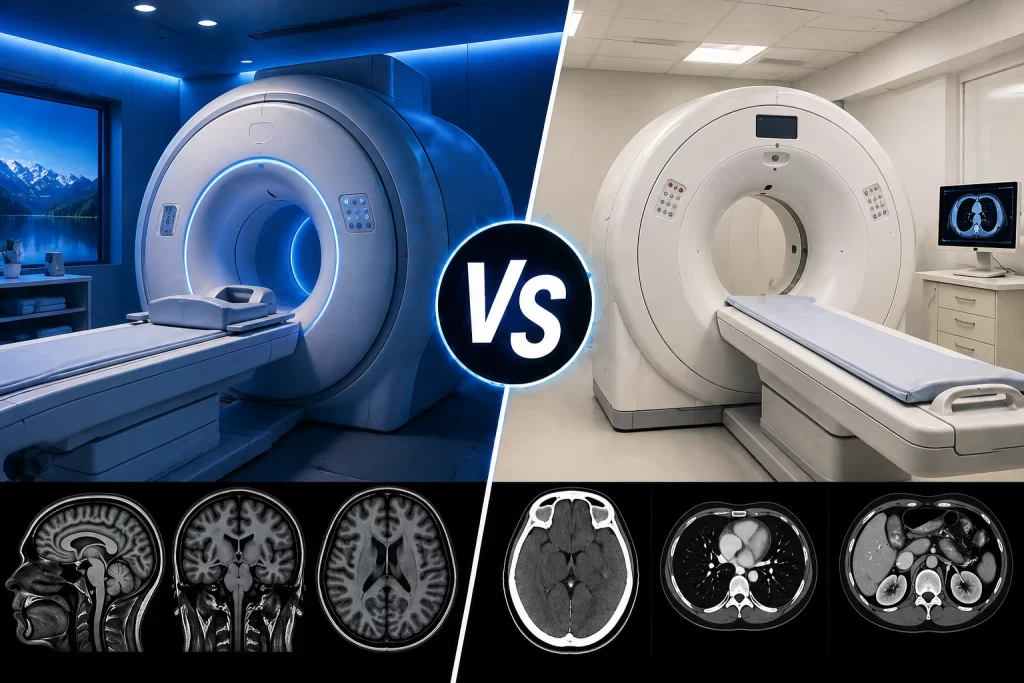
A CT scan uses X-rays. The machine rotates around your body, picks up images from multiple angles at once, and software builds those into cross-sectional slices. The whole scan typically takes five to ten minutes. It is excellent at imaging dense structures — bones, lung tissue, and solid abdominal organs. Because it is fast, CT is the standard first choice in emergencies.
MRI — Soft Tissue and Zero Radiation
An MRI uses a powerful magnetic field and radio waves — no radiation at all. It detects how water molecules in your body respond when placed inside that field. Since different tissues carry different amounts of water, the result is exceptional contrast in soft tissue. The brain, spinal cord, nerves, ligaments, and cartilage all show up with a clarity CT simply cannot match. The trade-off is time — an MRI typically takes 30 to 60 minutes, sometimes longer.
| 🏥 Explore Our Imaging Services at Meridian Hospital |
Which Scan Is Used for Which Condition?
The simplest rule: bone or emergency situations call for CT. Nerves, brain, joints, or soft tissue call for MRI. Here is a specific breakdown:
| Condition | Scan | Why |
| Back pain, disc or nerve compression | MRI | Unmatched detail of discs and nerve roots |
| Head injury or suspected brain bleed | CT First | Speed is critical — diagnosis cannot wait |
| Brain tumour, stroke, or MS | MRI | Superior contrast for soft brain tissue |
| Chest pain or suspected blood clot | CT | Standard thoracic imaging protocol |
| Knee, shoulder, or ligament injury | MRI | Only scan that clearly shows cartilage and tendons |
| Bone fracture assessment | CT | Sharper resolution for hard structures |
The Radiation Question — Answered Honestly
Yes, CT scans involve ionising radiation. A single scan carries a small but real dose. For most adults who genuinely need the test, this risk is clinically acceptable. Radiation accumulates though — someone who has had ten CT scans over the years carries a meaningfully higher total exposure than someone who has had one.
MRI has zero radiation. This is exactly why MRI is always preferred for children, pregnant women after the first trimester, and patients who need repeated imaging over time — people being monitored for cancer, or managing a spinal condition requiring regular check-ups.
If your doctor has ordered a CT, there is a clinical reason. If the radiation concerns you, ask whether MRI would answer the same diagnostic question. At Meridian Hospital, our specialist doctors are always available to walk you through the rationale before you proceed.
What to Expect During Each Scan
CT Scan Experience
Straightforward. You lie on a flat table that slides through a ring-shaped machine. You may be asked to hold your breath briefly. If contrast dye is needed, it is injected through a vein — you may notice a brief warmth or a faint metallic taste, both of which pass quickly. The whole thing wraps up in under fifteen minutes.
MRI Scan Experience
A bit different. The machine is loud — a series of clanging and thumping sounds throughout the scan. You will be given earplugs. You will lie inside a narrow tube for anywhere from 30 minutes to over an hour. Some patients find this claustrophobic. If you know you are anxious in enclosed spaces, let the booking team know in advance. Mild sedation can usually be arranged.
Before entering the MRI room, always tell the radiologist about any metal in your body. Pacemakers, surgical implants, metal clips, or fragments are serious contraindications. This is non-negotiable.
| 💡 Useful Links for Meridian Hospital Patients
→ Book an Appointment — Online or Call → 24/7 Emergency Services at Meridian Hospital |
Why Choose Meridian Hospital for Imaging in Chennai?
At Meridian Hospital, Kolathur, we have modern radiology infrastructure backed by experienced radiologists. Whether it’s a routine MRI or an urgent CT, our team ensures accurate results and clear communication every step of the way. Explore our full range of specialities or check our health check packages for comprehensive preventive care.
| Need an MRI or CT Scan in Chennai?
Meridian Hospital, Kolathur offers modern imaging equipment and experienced radiologists. meridianhospitals.in | #46D, Jawaharlal Nehru Road, Kolathur, Chennai – 600 099 |
The Right Scan Makes All the Difference
MRI and CT are not competing technologies. They are complementary tools designed for different clinical needs. Knowing the difference helps you ask the right questions and trust the diagnostic process.
At Meridian Hospital, Chennai, your imaging is handled by specialists who choose the right scan for the right reason — every single time.
Frequently Asked Questions
- Is MRI more accurate than CT scan?
For soft tissue — the brain, spinal cord, joints, and nerves — MRI is significantly more accurate. For bone injuries or emergency situations, CT is equally effective and faster. The honest answer is that neither is universally better. The right scan for your condition is the accurate one.
- Does CT scan have radiation in India?
Yes. CT scans use X-rays, which involve ionising radiation. A standard chest CT carries roughly the equivalent of two years of natural background radiation. Your doctor will only recommend a CT when the diagnostic benefit genuinely outweighs this risk. If you have concerns, speak to our doctors at Meridian Hospital before your scan.
- Which scan is better for back pain — MRI or CT?
MRI is almost always the recommended scan for back pain, especially when disc herniation, nerve compression, or spinal cord conditions are suspected. CT may be used if a fracture is the primary concern. Your orthopaedic or spine specialist will advise based on your exact symptoms.
- Can I request an MRI instead of a CT scan?
You can and should ask your doctor. In some cases MRI provides equivalent or better diagnostic information and your doctor may agree to switch the order. In emergencies or chest conditions, CT is the clinically correct choice and MRI will not serve the same purpose. Book a consultation at Meridian Hospital to get clarity before your scan.
- How long do scan results take at Meridian Hospital?
Emergency scans are reported immediately. Routine imaging typically has reports ready within 24 to 48 hours. Your doctor will review the findings and explain next steps. For urgent queries, use our 24/7 emergency line — 044 6666 9999.