A cough that won’t quit after a few weeks? Easy to blame on Chennai’s dust, the traffic fumes, “just a bad cold that’s hanging on.” And most of the time, honestly, that’s all it is. But here’s the uncomfortable part: lung cancer is one of the cancers doctors miss most often in its early stages, mainly because the first symptoms look exactly like ordinary respiratory complaints. Not dramatic. Not obviously alarming. Just a cough, or a bit of breathlessness, that doesn’t quite go away.
That overlap is exactly why it’s worth learning what actually separates “probably nothing” from “get this checked.”
Why catching it early actually matters
Lung cancer is sneaky in a specific way: it usually doesn’t announce itself until it’s already progressed. Breast lumps get found in a self-exam. Skin cancer shows up as a visible spot. Lung cancer, tucked away inside the chest, doesn’t give you much to notice until later. That’s part of why it tends to get diagnosed at a more advanced stage than cancers you can literally see or feel.
Here’s the flip side, though. Catch it while it’s still confined to the lung, and the range of treatment options opens up considerably, and outcomes tend to be meaningfully better. That’s really the whole case for paying attention to symptoms that seem minor, rather than waiting until something feels dramatic enough to force the issue.
Early signs of lung cancer worth taking seriously
- A cough lasting more than 3 weeks, or one that changes character, gets deeper, or just won’t quit
- Coughing up blood, or blood-tinged mucus, even a small streak
- Chest pain that gets worse when you breathe deeply, cough, or laugh
- Hoarseness that sticks around
- Losing weight without trying, without a diet change, without any obvious reason
- Getting winded doing things that never used to leave you breathless
- Repeated bouts of bronchitis or pneumonia, one after another
- Fatigue that doesn’t add up given how much you’re sleeping or working
Most of these, on their own, mean nothing. A cough is usually just a cough. But once something on that list has stuck around for the past two or three weeks, or keeps coming back, it’s earned a proper look rather than another bottle of cough syrup.
Who tends to be at higher risk?
Smoking history is the obvious one. Current and former smokers carry higher risk, and it climbs with how long and how much someone smoked, though it does fall gradually after quitting. Regular exposure to secondhand smoke counts too.
Then there’s occupational exposure: years around asbestos, diesel exhaust, or certain industrial chemicals adds up in ways people don’t always connect to lung health. Long-term exposure to heavy air pollution matters here as well, which is worth flagging given how dense and polluted a city like Chennai can get. A family history of lung cancer raises the baseline risk regardless of any of the above.
And one thing people consistently underestimate: non-smokers aren’t off the hook. A real share of lung cancer cases show up in people who’ve never smoked a day in their life, sometimes tied to genetics, radon exposure, or environmental pollutants nobody thinks to blame. Which is exactly why the symptoms above deserve attention no matter someone’s smoking history.
How doctors actually diagnose it
When lung cancer is suspected, the workup usually starts simple and gets more specific from there. A chest X-ray is typically first, just to spot anything that looks like an abnormal mass or shadow. If something turns up, a low-dose CT scan gives a far more detailed picture, and it’s also the recommended screening tool for people at high risk, generally older adults with a significant smoking history. A biopsy confirms whether a suspicious area is actually cancerous and identifies the exact cell type involved. From there, a PET scan or further imaging checks whether it’s spread anywhere, which shapes whatever treatment plan comes next.
What lung cancer treatment in Chennai typically looks like
There’s no single playbook here; treatment gets built around the specific case. That said, most lung cancer treatment in Chennai draws from the same toolbox other major centers use: surgery to remove the tumor where possible, chemotherapy, radiation therapy handled by a radiation oncologist, and increasingly, targeted therapy or immunotherapy for tumors with the right genetic markers. Which combination makes sense depends entirely on the scans, the biopsy results, and the patient’s overall health, so it’s genuinely a case-by-case call rather than something to plan around before a full diagnostic workup.
When it’s time to see someone
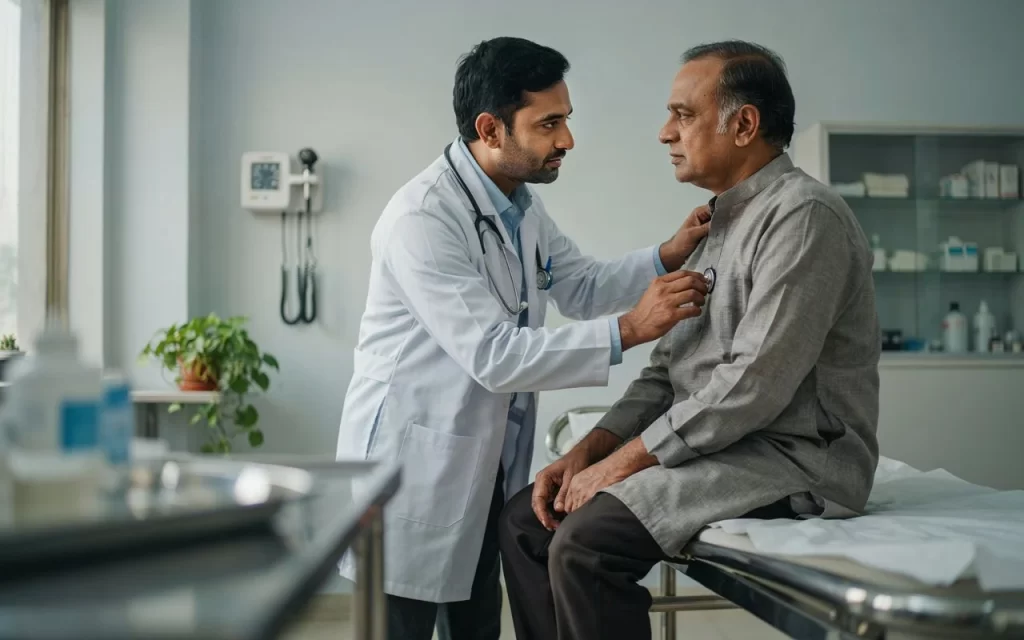
Persistent cough. Breathlessness that snuck up on you. Any of the warning signs above, sitting there for more than two or three weeks. That’s the point where “let’s just wait and see” stops being the right call. Meridian Hospital’s Oncology team in Kolathur, Chennai runs the full pathway here, from diagnostic imaging through to treatment, for whatever a workup turns up.
Got a cough or breathing trouble that won’t quit? Talk to Meridian Hospital’s Oncology department & Pulmonology, a leading cancer hospital in Chennai, and get it looked at properly.
This article is for general health education and doesn’t replace a medical diagnosis. Please see a doctor for any respiratory symptom lasting beyond two to three weeks.