
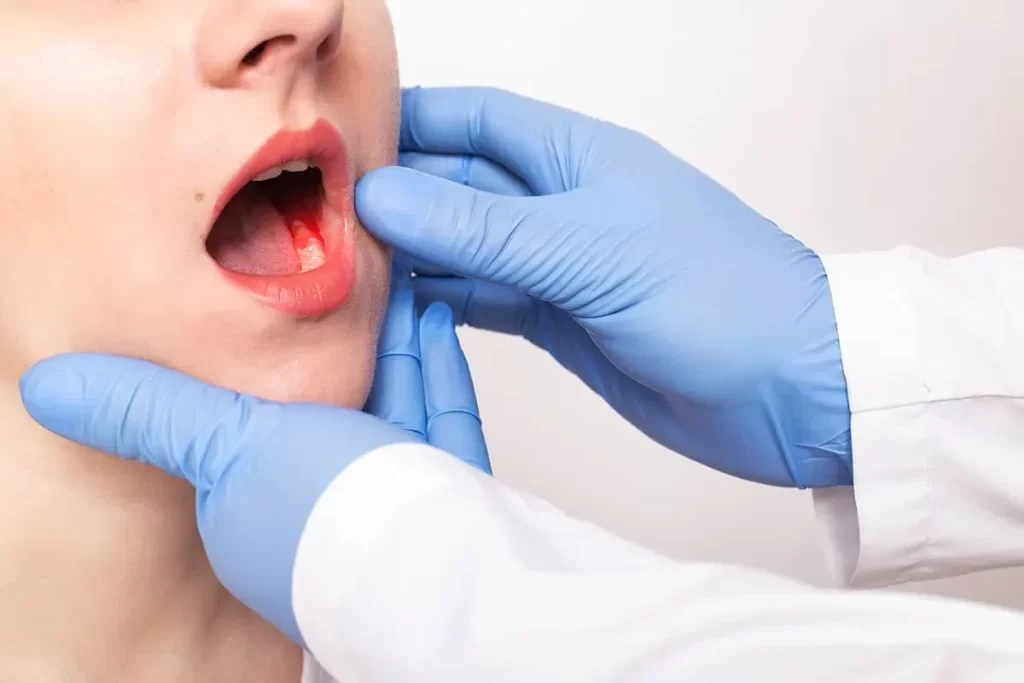
India accounts for nearly one-third of all mouth cancer cases worldwide. That number has a direct cause — and it’s not genetics, it’s not air pollution, and it’s not something mysterious. It’s paan, gutka, and areca nut. Habits that millions of Indians practise daily, often without any sense of the damage being done.
Mouth cancer symptoms in India go undetected for months — sometimes years — because the early signs look nothing like cancer. A sore that won’t quite heal. A patch of white on the inner cheek. A jaw that’s getting harder to open. Each dismissed as a minor oral issue until it isn’t minor anymore.
Here is what you actually need to know about these habits, the biology behind the damage, and why catching this early is the single most important factor in how the story ends.
| ⚡ Quick Answer: What are the early signs of mouth cancer in India?
A white or red patch inside the mouth, a non-healing ulcer lasting more than two weeks, difficulty opening the jaw, unexplained bleeding, or a lump in the cheek or under the jaw — these are the key early warning signs. If anyone is using paan, gutka, or areca nut, any one of these symptoms requires a doctor’s evaluation within the week. |
Why These Habits Are So Much More Dangerous Than People Realise
Betel nut on its own — before you even add tobacco — is classified by the World Health Organisation as a Group 1 carcinogen. That’s the same category as tobacco smoke and asbestos. Not ‘possibly harmful.’ Definitely cancer-causing in humans.
Add slaked lime (chuna), which makes the mouth more alkaline and dramatically increases how efficiently carcinogens are absorbed through the lining. Then layer in tobacco, which brings nitrosamines — some of the most potent cancer-causing compounds known to medicine. The combination isn’t additive. It’s multiplicative.
| 🧪 The Chemical Breakdown
Areca nut (supari) → WHO Group 1 carcinogen — cancer-causing in humans Slaked lime (chuna) → Increases alkalinity, accelerates carcinogen absorption Tobacco → Adds nitrosamines — potent carcinogens Combined effect → Multiplicative, not additive — the damage compounds rapidly |
What happens in the mouth over years of this exposure is called oral submucous fibrosis — a condition most people have never heard of, but many gutka users are walking around with. The inner lining of the mouth gradually stiffens. Opening wide becomes harder. There’s a burning sensation when eating spicy food. The tissue changes at a cellular level — and in a meaningful percentage of cases, that changed tissue becomes cancerous.
The window between ‘this is manageable’ and ‘this is cancer’ is something patients usually only understand in retrospect.
The Mouth Cancer Symptoms Most People Dismiss
Here’s what makes oral cancer so difficult to catch early: the first signs look almost nothing like cancer. They look like a mouth ulcer that won’t quite heal. A slightly rough patch on the inside of the cheek. A jaw that feels a little stiff in the morning.
These are the mouth cancer symptoms in India that get dismissed for weeks — sometimes months — before anyone thinks to get them checked:
Warning Signs That Need Immediate Medical Evaluation
- A white or red patch inside the mouth that has been there for more than two weeks and is not getting better
- A sore or ulcer that heals partially and then comes back, or simply never heals
- Difficulty opening the mouth fully — or a jaw that has become noticeably harder to open over the past months
- Unexplained bleeding from the gums or tongue without dental cause
- A lump or thickening anywhere inside the cheek, on the tongue, or under the jaw
- Numbness in the lips or tongue with no clear dental explanation
- A hoarse or changed voice that has lasted more than three weeks
| ⚠️ One Rule to Remember
Any one of these symptoms, in someone who uses paan, gutka, or tobacco in any form, deserves a doctor’s attention. Not next month. This week. |
The ‘Plain Paan is Safe’ Myth — Let’s Put That to Rest
This comes up constantly. ‘I don’t use tobacco. My paan is just betel leaf, supari, and chuna. That’s fine, right?’
| It isn’t. The WHO’s Group 1 classification for areca nut does not have a tobacco exemption. The nut itself — the supari — is the problem. Chuna amplifies the damage. Even without a single strand of tobacco, regular paan is a documented cause of oral cancer and oral submucous fibrosis. |
This isn’t about being alarmist. It’s about accuracy. Millions of people in Tamil Nadu, Andhra Pradesh, and across India use paan without tobacco and believe they are safe. The clinical evidence says otherwise.
What Happens When You Finally Go to the Doctor
If a doctor or dentist spots something suspicious during an examination, the next step is a biopsy — a small tissue sample taken from the area, examined under a microscope. It is a minor procedure. What it tells you is not minor at all.
If cancer is confirmed, staging follows — usually with an MRI or CT scan to understand how far it has spread. The stage at diagnosis is the single biggest predictor of outcome:
| Stage | Description | 5-Year Survival |
| Stage I | Small tumour, localised to one area, no lymph node involvement | 80–90% |
| Stage II | Larger tumour, still localised, no lymph node spread | 70–80% |
| Stage III | Tumour spread to nearby lymph nodes, more complex surgery required | 50–60% |
| Stage IV | Spread to distant lymph nodes or other structures, aggressive multi-modal treatment | 30–40% |
The difference between Stage I and Stage III is often just a matter of months — and whether someone took an early symptom seriously. Stage 1 and Stage 2 oral cancers, treated with surgery and sometimes radiation, have survival rates above 80%. Stage 3 and Stage 4 are more complex, require aggressive treatment, and the outcomes are significantly less predictable.
It Is Not Too Late to Stop
One of the most common questions asked at Meridian Hospital’s oncology consultations: ‘I’ve been using gutka and Tobacco for 20 years. Is it too late to stop?’
The answer is always the same. No. Stopping now absolutely reduces the ongoing risk and gives the body a genuine chance to recover. Oral submucous fibrosis doesn’t fully reverse on its own, but its progression can be halted. The earlier you stop, the better. And no amount of past damage is a reason to continue.
| ✅ What Quitting Does for Your Oral Health
Stops new carcinogen exposure immediately • Allows the oral mucosa to begin recovery • Significantly reduces cancer progression risk • Makes any existing lesions easier to monitor and treat • Improves surgical and treatment outcomes if cancer is already present |
Conclusion
India’s mouth cancer burden is not inevitable. It is driven almost entirely by a set of preventable habits — and the fact that those habits are normalised across generations, across social classes, and across regions makes the conversation harder but no less urgent.
Biology is not complicated. Areca nut is a carcinogen. Tobacco multiplies the damage. Years of exposure change tissue in ways that can and do become cancerous. But the same biology that makes this dangerous also makes early intervention powerful — catch it at Stage I, and the outlook is genuinely good.
If you or someone in your family uses paan or gutka — even without tobacco — an annual oral cancer screening at Meridian Hospital, Kolathur, Chennai is the most straightforward thing you can do right now. You can Check our other blogs like Understanding Modern Cancer Treatments: Diagnosis, Therapy & Recovery.
| Why Choose Meridian Hospital?
A mouth sore that won’t heal. A white patch. A jaw that’s getting harder to open. These need attention now — not later. At Meridian Hospital, Kolathur, Chennai, our oncology and oral medicine team provides expert evaluation, early-stage biopsy, and comprehensive cancer care — from diagnosis through treatment and recovery. Early detection saves lives. Book your appointment at Meridian Hospital, Kolathur, Chennai. Call us or visit our website today. |
Frequently Asked Questions
Q1. Can I stop using gutka and reverse the damage?
Stopping absolutely reduces the ongoing risk and gives the body a chance to recover. Oral submucous fibrosis does not fully reverse on its own, but its progression can be halted when the habit is discontinued. The earlier you stop, the better. No amount of damage accumulated so far is a reason to continue.
Q2. How is oral submucous fibrosis treated?
Treatment includes stopping all areca nut and tobacco use, nutritional support, physiotherapy to improve mouth opening, and in some cases, intralesional injections or surgery. The most important step remains quitting the habit — without that, no treatment is effective long-term.
Q3. My mouth ulcer has been there for 10 days. Should I be worried?
A mouth ulcer lasting more than two weeks — especially in someone who uses paan or gutka — should be evaluated by a doctor without delay. Most ulcers are benign. But the only way to know for certain is to have it examined. Do not wait and hope.
Q4. Is plain paan without tobacco safe?
No. The WHO classifies areca nut (supari) as a Group 1 carcinogen — definitively cancer-causing in humans — regardless of whether tobacco is present. Slaked lime (chuna) amplifies the damage. Plain paan is a documented cause of both oral cancer and oral submucous fibrosis.
Q5. How often should gutka or paan users get screened for mouth cancer?
Anyone who uses or has used paan, gutka, or areca nut regularly should have an oral cancer screening at least once a year — ideally every six months. This is a simple visual examination by a doctor or dentist and takes only a few minutes. Early detection at Stage I or II dramatically improves outcomes.