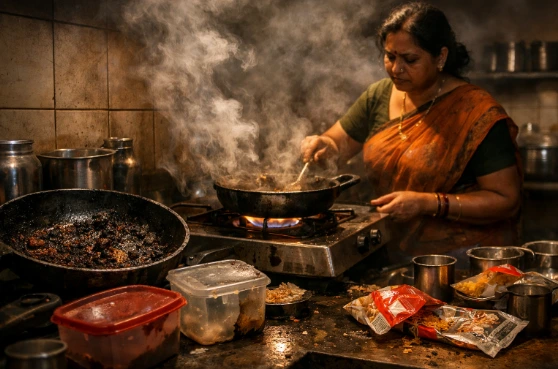
Your kitchen feels like the safest place at home. You cook there every day. You feed your family there.
But some habits — small ones you barely notice — may slowly raise your cancer risk over time.
This is not about fear. It is about knowing what to look for. Because most of these habits are easy to change once you know they matter.
1. Reusing Cooking Oil Again and Again
After deep frying, most homes save the leftover oil. It gets strained and used the next day. And maybe the day after that.
Here is the problem. Every time you heat oil to a high temperature, it breaks down. It releases harmful compounds that have been linked to digestive cancers.
Sunflower oil, groundnut oil, and vanaspati are especially sensitive to this. The more times they are reheated, the more they degrade.
Old, reheated oil looks the same. But chemically, it is a very different substance from what you started with.
Quick Fix: Use fresh oil each time you cook. If you reuse, do it only once — and never reuse oil that looks dark, smells odd, or foams when heated.
2. Cooking on Very High Flame Until Food Burns
Tamil Nadu cooking runs on high heat. A hot tawa, fast tempering, oil at smoking point in seconds.
When starchy foods — dosa, roti, rice, potatoes — get charred or heavily browned at high heat, they produce a chemical called acrylamide. It forms naturally in this process. And it has been classified as a probable cancer-causing compound.
Burnt dosa edges, black-bottomed rotis, over-roasted snacks — they taste fine. But they carry a chemical cost your body pays over time.
Quick Fix: Keep the flame moderate. Aim for golden-brown, not dark brown or black. If food does char, scrape off the burnt layer before eating.
3. Cooking in a Kitchen With No Ventilation
Many Chennai homes — older buildings, compact flats — have small or no windows in the kitchen. No chimney. No exhaust fan.
Cooking smoke contains carbon monoxide, nitrogen dioxide, and fine particles. When you cook in a closed kitchen, you breathe all of this in — every single day.
Research across South and Southeast Asia shows that women who cook daily in poorly ventilated spaces have significantly higher rates of lung cancer than those who cook with good airflow. Even on LPG, not just wood or kerosene.
You do not need to be a smoker to breathe in something harmful. A closed kitchen with a hot stove can have a similar slow effect over years.
Quick Fix: Open windows before you start cooking, not after. Run your exhaust fan every time you cook. If you do not have one, install it — it is worth far more than its cost.
4. Heating Food in Plastic Containers
Reheating last night’s curry in a plastic container. Hot sambar stored in a plastic cover. Food covered with cling film is immediately after coming off the stove.
Plastic doesn’t just get soft as it heats up: chemicals in the plastic — including bisphenol A (BPA), phthalates or other chemicals in its composition — may leach into your food when you heat it. Many of those chemicals can modify how your body uses hormones, and many of those chemicals have been studied for their links to breast and prostate cancer.
There is such a thing as safer plastics, but if there’s a clearly safer alternative, the choice should be clear — take the safer option.
Quick Tips: If you are cooking with something hot from the microwave, choose to use either glass, stainless steel or ceramic. If you cannot do so within the restriction of using only the approved plastics that are labelled for use in microwaves, then choose to reheat your food using glass only.
5. Charred and Processed Meats
Grilled chicken over charcoal, seekh kebabs with dark char marks, sausages from the packet — these are weekend staples for many Chennai families.
When meat is cooked over very high heat or direct flame, it produces two types of harmful compounds: heterocyclic amines and polycyclic aromatic hydrocarbons. Both are classified as probable carcinogens by major health organisations.
The darker the char, the higher the concentration of these compounds on the meat’s surface.
Processed meats are a separate concern. The World Health Organisation has classified them as Group 1 carcinogens — meaning there is strong evidence linking them to colorectal cancer.
Quick Fix: Marinate meat before grilling — this reduces harmful compound formation. Avoid cooking directly over open flame for long periods. Treat processed meats as an occasional food, not a daily one.
Small Habits. Big Difference Over Time.
Indian food is not the problem. Turmeric, ginger, garlic, lentils, fresh vegetables — these are genuinely protective foods. The risks here come from specific cooking habits, not the cuisine itself.
Cancer risk from kitchen habits builds slowly. Over years. Most people will never notice it happening. That is exactly why it matters to act before symptoms arrive.
Here is what you can do starting today:
- Use fresh oil each time — or reuse only once.
- Open your kitchen windows before cooking.
- Keep the flame moderate and avoid charring food.
- Switch to steel or glass for storing and reheating hot food.
- Eat processed and charred meats less often.
None of these cost much. None require a new kitchen. They just require a small shift in a habit you have probably had for years.
When Should You See a Doctor?
Cancer risk from kitchen habits builds over decades. But some symptoms should not be ignored:
- Persistent bloating or stomach discomfort
- Unexplained weight loss
- A cough that does not go away after a few weeks
- Changes in digestion that last longer than two or three weeks
If any of these sound familiar, do not wait. Early detection changes outcomes in a way that late detection simply cannot.
Meridian Hospital is a trusted multispeciality hospital in Chennai with a dedicated oncology team offering cancer screenings, surgical oncology, radiation oncology, and personalised cancer care. As one of the best hospitals for cancer treatment in Chennai, we are equipped to help you understand your risk — before symptoms become something more serious.
Talk to Our Cancer Care Team at Meridian Hospital, Chennai
Our oncology specialists — including the best surgical oncologists and medical oncologists in Chennai — offer cancer risk assessments, preventive screenings, and personalised advice for patients across Chennai and Tamil Nadu.
Located in Kolathur, Meridian Hospital is a 24-hour multispeciality hospital with advanced cancer care, emergency services, and cardiology under one roof. If you have concerns — or just want to understand your risk better — we are here. Book a consultation today.
Check out our other blogs about Understanding Modern Cancer Treatments: Diagnosis, Therapy & Recovery